Why Every Kid Needs a Hero Worth Imitating
I was a kid with a cape before I was a kid with much of anything else figured out.
Long before I had language for courage, sacrifice, or doing the right thing when nobody's watching, I had superheroes. I filled sketchbooks with them, ran through the backyard as one, and let their stories quietly shape what I thought strength was supposed to look like. I didn't know it at the time, but I wasn't just being entertained — I was being formed. Every hero I loved as a kid was teaching me something about who I wanted to become.
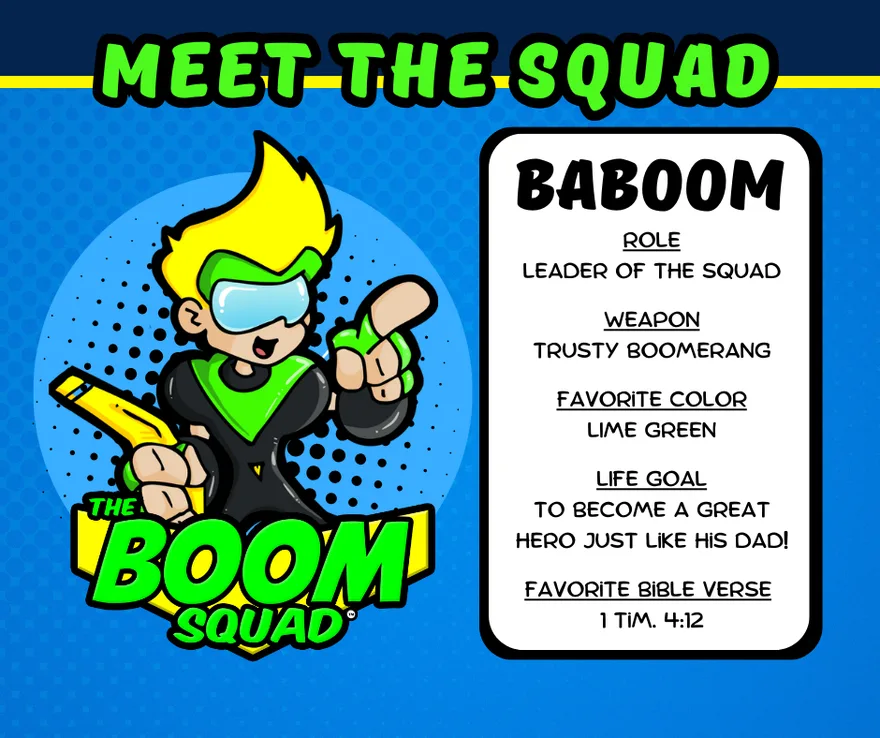
That's the whole idea behind The Boom Squad. But before it was a brand, it was just true: kids don't outgrow the need for heroes. They just decide, early and many without words, who theirs are going to be.
That decision matters more than most of us give it credit for. And it's exactly why this one's for you — the parents, grandparents, teachers, and ministry leaders who are, whether you signed up for it or not, the ones showing potential heroes to children.
Kids Become Who They Admire
Here's something every parent eventually notices: kids don't imitate what you tell them to; they imitate who they admire. Long before a child can articulate a value system, they can point at someone and say, "I want to be like that." And then, quietly, relentlessly, they start becoming it.
That's not a flaw in how kids are wired. It's the design. God built children to look outward for a pattern before they're mature enough to build one from scratch — which means the adults and stories surrounding a child aren't neutral background noise. They're raw material for young souls in progress.
So the real question isn't whether your child will have heroes. They will. The question is whether the heroes available to them are actually worth becoming.
What My Childhood Heroes Got Right
I'll be honest — a lot of what I loved about superheroes as a kid wasn't complicated. Costumes are fun. Powers are cool. Villains getting what's coming to them feels satisfying at any age. Plus, I loved pizza as much as the next ninja turtle.
But underneath the fun, something real was getting through. The heroes I loved almost never won because they were the strongest person in the room. They won because they showed up when it was hard, protected people who couldn't protect themselves, and kept going after they'd already been knocked down. Somewhere in all that spandex and special effects was a pretty solid first draft of courage, sacrifice, and standing up for someone besides yourself.
That's the same conviction behind every Boom Squad story: a hero isn't someone who's stronger than others; a hero is someone who knows where real strength comes from, and uses it to serve the greater good. Fiction can plant that seed early, in a form a child will actually sit still for. But fiction was never meant to be the whole answer. It's an echo of something God did first.
The Bible Is Full of Heroes On Purpose
Open Scripture and you don't find a dry list of rules. You find a library of stories — and an astonishing number of them are hero stories. A shepherd boy facing a giant with a sling. A young woman risking her life to save her people from inside a palace. A prophet standing alone against an evil king. A fisherman stepping out of a boat onto water that shouldn't hold him.
Hebrews 11 goes as far as naming names — a whole chapter God devoted to a roll call of ordinary, flawed people who did extraordinary things because they trusted Him:
"By faith Abraham... by faith Moses... by faith the walls of Jericho fell... These were all commended for their faith." — Hebrews 11 (selected)
None of these people were perfect. Moses had a temper and an ugly past. David made choices he spent the rest of his life grieving. Rahab wasn't exactly a model citizen before God used her anyway. That's not incidental; it's the point. The Bible doesn't give children flawless heroes. It gives them real ones, who were afraid and obeyed anyway. That's a far more useful role model than an invincible one, because it's the kind of hero a child can actually grow up to be.
But Every One of Them Points Past Themselves
Here's what keeps the Bible's heroes from becoming just another list of impressive people to admire from a distance: not one of them is the point.
Abraham, Moses, David, Esther, Daniel — every single one of their stories is quietly pointing down the page toward Someone else. The writer of Hebrews finishes that whole roll call of heroes by turning the reader's eyes forward:
"Therefore... let us run with endurance the race that is set before us, looking unto Jesus, the author and finisher of our faith." — Hebrews 12:1–2
Jesus is the only Hero in the story who never had a flaw to overcome — and He didn't use that perfection to diminish others, dominate his rivals, or gloat over his enemies. He used it to lay His life down for people who couldn't save themselves. Real strength, at its absolute highest, looks like a King who knelt down to wash dirty feet. Every hero children read about — in Scripture, and in the stories we tell alongside it — is only ever a signpost pointing toward that one hero.
That's the whole reason "Become the hero God created you to be" means something different in our stories than it does anywhere else. It was never about becoming powerful. It's about becoming like Him, becoming like Jesus.
Telling Them Isn't Optional — It's Commanded
Here's the part I think gets missed most. God didn't just give His people a history worth remembering — He gave them a direct instruction to keep telling it, on purpose, generation after generation:
"These commandments... impress them on your children. Talk about them when you sit at home and when you walk along the road, when you lie down and when you get up." — Deuteronomy 6:6–7
"We will not hide them from their descendants; we will tell the next generation the praiseworthy deeds of the LORD." — Psalm 78:4
That's not a suggestion for people who happen to enjoy storytelling. That's a command for every parent, grandparent, and spiritual leader whose kids are watching. Passing down God's story, and the heroes He raised up inside it, is a spiritual assignment, not extra entertainment. If we don't hand our children better heroes on purpose, the culture around them will hand them worse ones by default.
What This Looks Like for You
If you're a parent or grandparent: Let your kids see you love the Bible's heroes out loud. Talk about David like he's fascinating, not just familiar. Ask what they'd have done in Esther's shoes. Let the superhero movie you watch together on a Friday night become the on-ramp to a conversation about a real one Sunday morning.
If you're an educator: You spend more waking hours shaping a child's sense of "who's worth admiring" than almost anyone outside their home. A well-placed story about courage or integrity does more character work in five minutes than a lecture does in fifty.
If you're a minister or ministry leader: Don't be afraid to let the fun stay fun. Kids don't need the heroic parts of Scripture flattened into a moral before they're allowed to enjoy them as a good story first. Let David versus Goliath be thrilling before it's instructive — the lesson lands harder, not softer, when the story was allowed to be great first.
The Hero-Makers
Every child is going to have heroes. That was never in question. What's still very much up to us is which ones — and whether those heroes eventually lead somewhere real.
That's the work behind everything we build at The Boom Squad: giving kids a hero story they genuinely love, that quietly keeps pointing past the cape and the boomerang toward the truth every biblical hero was chasing — that real strength comes from God, is seen perfectly in Jesus, is given to us by the Holy Spirit, and is meant to be used for good.
You don't have to write books to do this work. You're already doing it, every time you choose which stories get told at your table, in your classroom, or from your platform.
Become the hero God created you to be.
RISE ABOVE. POWER, POWER UP.